





 +60173309581
Step-by-Step Guide to Applying to Malaysian Universities Online in 2026
August 10, 2026
Mehmil

So, you've set your sights on studying in Malaysia for 2026? Fantastic choice.
The country offers a vibrant culture, world-class education, and surprisingly affordable living costs.
But between you and your dream course stands the application process — a mountain of paperwork, confusing acronyms, and dozens of tabs open comparing universities you've never visited.
Here's the good news: you don't have to do this the hard way.
Let's walk through what the process actually looks like, where students typically get stuck, and how applying through Easyuni turns a stressful multi-month slog into something far more manageable.
⚡ Quick Answer: The fastest way to apply to a Malaysian university in 2026 is through EasyUni, where you can compare universities and courses, check scholarship eligibility, and apply with counselor support—all in one place.
Key Takeaways: Your Application at a Glance
The process has real friction points — course selection, document prep, tracking multiple applications, and understanding scholarships all take time and can easily go wrong.
Easyuni removes the guesswork — compare courses and universities side by side, get matched to the right fit, and apply without juggling five different portals.
Scholarships are easy to miss — Easyuni surfaces the ones you actually qualify for, instead of you hunting blindly.
You're not on your own — dedicated counselor support walks you through the entire journey, and that support doesn't stop once you land in Malaysia.
EMGS is still central — every international student eventually needs an EMGS-processed Student Pass, regardless of how you apply.
Before You Apply: The 2026 Malaysian University Landscape
Malaysia is serious about becoming a top international education hub, and 2026 continues to see strong growth in technology, business, and health & medicine programs. That's great news — more choice, better facilities, more scholarship money on the table.
But more choice also means more decisions.
With hundreds of universities and thousands of courses to sift through, "just pick one" isn't realistic advice. This is the first hurdle, and it trips up more students than any visa form ever will.
Main intakes are generally in January, April, July, and September — but deadlines vary by faculty, so always confirm the specific date for the course you want.
How the Application Process Actually Works
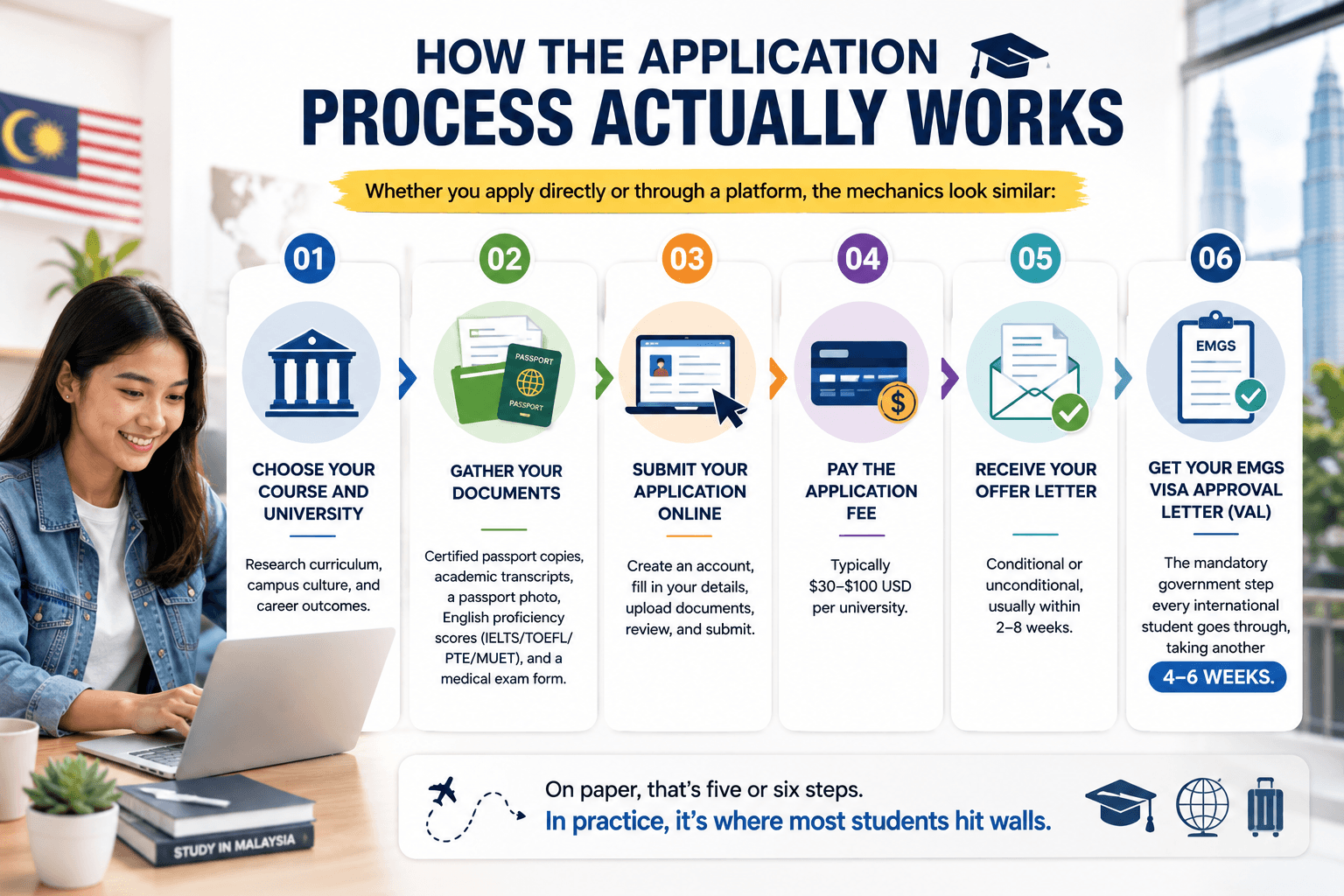
Whether you apply directly or through a platform, the mechanics look similar:
👉 Choose your Course and University: Research curriculum, campus culture, and career outcomes.
👉 Gather your Documents: Certified passport copies, academic transcripts, a passport photo, English proficiency scores (IELTS/TOEFL/PTE/MUET), and a medical exam form.
👉 Submit your Application Online: Create an account, fill in your details, upload documents, review, and submit.
👉 Pay the Application Fee: Typically $30–$100 USD per university.
👉 Receive your Offer Letter: Conditional or unconditional, usually within 2–8 weeks.
👉 Get your EMGS Visa Approval Letter (VAL): The mandatory government step every international student goes through, taking another 4–6 weeks.
On paper, that's five or six steps. In practice, it's where most students hit walls.
The Real Hurdles Students Run Into
Let's be honest about what actually slows people down:
1. "I don't know which university is actually right for me."
Rankings don't tell you about teaching quality, campus vibe, or whether a specific course leans toward AI or cybersecurity within the same "Computer Science" title. Picking blind, or picking based on name recognition alone — is how students end up transferring or regretting their choice a year in.
2. "I'm applying to five universities and it's chaos."
Different portals, different logins, different document formats, different deadlines. Re-uploading the same transcript five times, in five different formats, is nobody's idea of a good use of a Tuesday.
3. "I have no idea what scholarships I even qualify for."
Scholarship information is scattered across university websites, buried in PDFs, or simply not surfaced to international applicants at all. Students routinely leave money on the table simply because they never found out it existed.
4. "I don't have anyone to ask when something goes wrong."
A typo in a passport number, a missing document, a confusing EMGS status update — when you're applying alone, there's no one to sanity-check your next move.
5. "What happens once I actually land in Malaysia?"
Most guides stop at the visa. But your first weeks in a new country, accommodation, registration, getting settled — come with their own set of questions nobody prepared you for.
Why Easyuni Is the Better Way to Apply
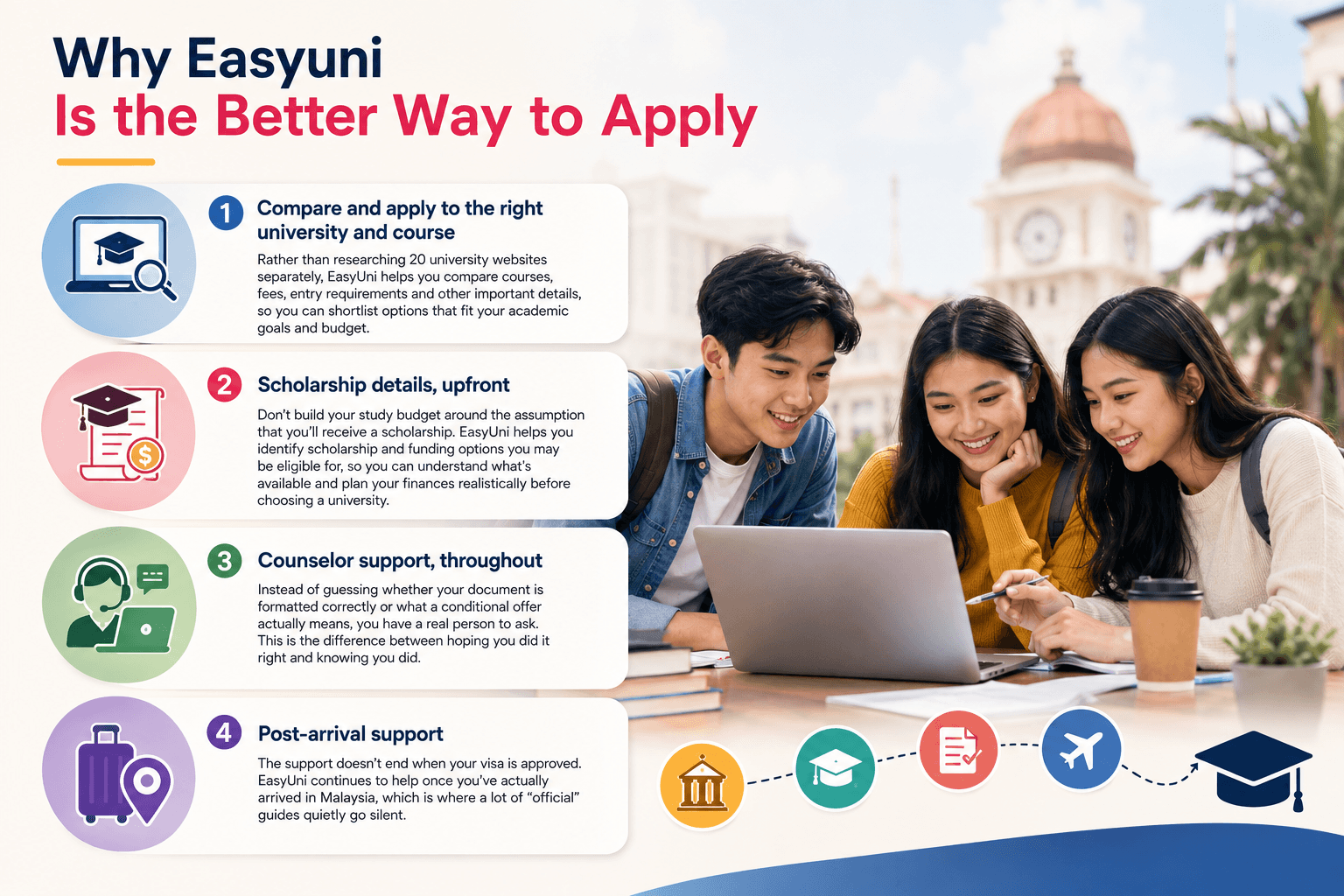
This is exactly the gap Easyuni is built to close. Instead of treating "apply online" as one isolated step, Easyuni supports the entire journey:
1. Compare and apply to the right university and course
Rather than researching 20 university websites separately, EasyUni helps you compare courses, fees, entry requirements and other important details, so you can shortlist options that fit your academic goals and budget.
2. Scholarship details, upfront
Don’t build your study budget around the assumption that you’ll receive a scholarship. EasyUni helps you identify scholarship and funding options you may be eligible for, so you can understand what’s available and plan your finances realistically before choosing a university. Get scholarship details here.
3. Counselor support, throughout
Instead of guessing whether your document is formatted correctly or what a conditional offer actually means, you have a real person to ask. This is the difference between hoping you did it right and knowing you did.
4. Post-arrival support
The support doesn't end when your visa is approved. Easyuni continues to help once you've actually arrived in Malaysia, which is where a lot of "official" guides quietly go silent.
In short, you can apply directly to a university or manage the visa process yourself. But EasyUni adds a layer of personalised guidance across the decisions that matter — from choosing the right course and understanding your funding options to preparing your application and getting ready to start university.
EasyUni counselling is 100% free. Our advisors help you understand your options based on your academic background, budget, and goals—not by promising scholarships or outcomes that aren't guaranteed. Our goal is to help you make an informed decision about where and what to study.
Best Way to Apply to Malaysian Universities in 2026
If you already know exactly which university and course you want, applying directly is perfectly fine.
But if you're still comparing universities, checking fees and entry requirements, or exploring scholarship options, EasyUni can make the process much easier. Instead of researching everything separately, you can explore your options in one place and get guidance from an advisor when you have questions.
For students asking, “Is EasyUni better than applying directly?” — the honest answer is: it depends on where you are in your decision-making.
If you've already made your choice, applying directly may be the simplest option. If you're still deciding, comparing options, or need guidance through the application process, EasyUni gives you an easier way to explore your choices and get support along the way.
Direct vs. Easyuni: Which Application Route Fits You?
| What You Get | Apply Direct | Apply via EasyUni |
|---|---|---|
| Best for | Students set on one specific university | Students still comparing options |
| Compare multiple universities at once | No | Yes |
| Scholarship matching | No | Yes |
| Counselor support | No | Yes |
| Post-arrival support | No | Yes |
| EMGS fee & documentation | Required | Required |
Fees and Payment
Regardless of how you apply, budget for:
- University Application Fee: $30–$100 USD, paid per university.
- EMGS Processing Fee: approx. RM 4000
Your Offer Letter and the EMGS Visa Process
Once you receive your offer letter (conditional or unconditional), accept it formally and pay the deposit, which usually counts toward your first semester's tuition.
From there, the university submits your application to EMGS for your Visa Approval Letter (VAL) — the document you need to legally enter Malaysia as a student. This step takes 4–6 weeks, after which you'll get a single-entry visa sticker, later converted into a Student Pass once you arrive.
Key Application Deadlines for 2026 Intakes
Aim to apply 3–4 months ahead of your intake:
- January 2026 Intake: Apply by September–October 2025.
- April 2026 Intake: Apply by December 2025–January 2026.
- August 2026 Intake: Apply by March–April 2026.
- October 2026 Intake: Apply by May–June 2026.
Frequently Asked Questions
1. How can I apply for university in Malaysia as an international student?
You can apply directly through a university's portal, through EMGS, or through a platform like Easyuni that lets you compare and apply to multiple universities in one place, with counselor support along the way.
2. What are the requirements to study in Malaysia?
A valid passport (18+ months validity), certified academic transcripts, a passport photo, and proof of English proficiency.
3. How much does it cost to apply?
Typically $30–$100 USD per university application, plus an EMGS processing fee of about RM4000 after your offer.
4. Do I need an agent to apply?
No — you can apply directly to a Malaysian university. EasyUni is not your typical agent where you're simply handed a list of universities and told to apply. We help you compare your options, understand entry requirements and fees, explore available scholarship options.
5. What is the deadline for 2026 applications?
It varies by course, but aim to apply 3–4 months before your intake month.
6. Is it easy to get admission in Malaysia?
Generally yes, if you meet the academic and English requirements — though competitive courses like medicine will have higher standards. Comparing your options properly (rather than applying blind) makes a real difference in outcome.
7. What is the easiest way to apply to a Malaysian university?
Using a comparison and application platform like Easyuni is generally the easiest route, since it lets you research, compare, and apply to multiple universities from a single profile instead of repeating the process on each university's separate website.
8. How do I find scholarships for studying in Malaysia?
Scholarship information is often scattered across individual university sites. Platforms like Easyuni surface scholarship options matched to your profile as part of the application process, making them easier to find than searching manually.
9. What support is available after I arrive in Malaysia?
Support shouldn't stop at the visa stage. Easyuni offers post-arrival support to help with the transition once you've landed, covering questions that come up in your first weeks that most application guides don't address.
10. Is Easyuni free to use for students?
Easyuni's comparison and counselor support is designed to help students at no cost for using the platform itself; university and EMGS fees still apply separately regardless of which route you use to apply.
Kickstart your education in Malaysia
We'll help you find and apply for your dream university
You might be interested in...
- Top Actuarial Science Universities in Malaysia for International Students 2026
- 7 Advantages of Graduating from a Malaysian University in 2026
- Malaysian Cuisine and Dining Etiquette for International Students
- How to Apply to a University in Malaysia as an International Student
- 15 Best Universities in Malaysia for International Students (2026 Guide)
- International Graduates' Experiences: Their Academic Journey in Universities in Malaysia
- Extracurricular Activities for Students in Universities in Malaysia
- A Foodie’s Guide to Malaysian Campus Life
- From Local to Global: The Rise of Malaysia's Universities in International Rankings
- International Student Guide: Applying for a Malaysian Student Visa