





 +60173309581
How Much Does It Cost to Study Medicine in Malaysia? (2027 Fees for International Students)
October 20, 2026
Mehmil

Studying medicine in Malaysia can cost several hundred thousand ringgit, and tuition is only part of the budget.
International students also need to account for accommodation, food, student visa charges, medical insurance and other expenses throughout their degree.
This guide explains the main costs of studying medicine in Malaysia, using published university fee information and practical budgeting estimates to help international students and their families plan ahead
The Short Answer
For most international students, the tuition for a 5-year MBBS in Malaysia ranges from roughly RM375,000–RM720,000 , depending on the university.
Add a foundation year if you need one, living costs, visa and insurance, and the realistic all-in total is usually somewhere between RM520,000 and RM950,000.
That is a wide range, and we'd rather tell you that honestly than give you a single "affordable" number.
Where you land depends mostly on the university you pick and the city you live in.
Below, we break down every cost, show where the figures come from, and point out what to double-check.
MBBS Cost in Malaysia at a Glance: Tuition, Living, Visa and Insurance
| What You're Paying For | Estimated Range (RM) | When You Pay |
|---|---|---|
| MBBS tuition (5 years) | RM375,000–RM720,000 approx | Per semester or per year |
| Foundation / pre-university (if needed) | About RM 27,000 to RM 36,000 | Once, before MBBS |
| Living costs | About RM 2,000 to RM 3,500+ per month | Monthly |
| Student pass and visa (first year) | Roughly RM 2,200 to RM 4,000, depending on university and nationality | Once, before you arrive |
| Health insurance (renewal years) | Roughly RM 450 to RM 750 per year | Yearly, from year two |
| Application and registration fees | Varies; around RM 500 to RM 950 (application) and RM 1,000 to RM 3,400 (registration) | Once |
| Arrival and setup | Deposit of one to two months' rent, plus about RM 500 to RM 800 for basics | When you arrive |
1. MBBS tuition fees in Malaysia for international students
Tuition is the biggest cost, by far. International students usually pay more than local students at the same university.
Here are some examples of the total estimated cost for international students on a 5-year MBBS:
| University | Total Fees for 5 Years (International) |
|---|---|
| SEGi University | About RM 450,000 to RM 483,600 |
| AIMST University | About RM 319,750 to RM 369,000 |
| University of Cyberjaya (UoC) | About RM 405,000 to RM 435,000 |
| Newcastle University Medicine Malaysia (NUMed) | About RM 132,000 base tuition per year, plus RM 7,920 SST, giving RM 139,920 per year |
| International Medical University (IMU) | About RM 692,680 in tuition for the five-year programme, before applicable 6% SST |
What Is the Difference Between Tuition and Total Payable Fees?
Tuition fees: cover the academic programme, while total payable fees may include registration, administration, visa processing and other compulsory charges.
For example, IMU lists five-year international MBBS tuition at RM692,680, excluding applicable SST. If 6% SST applies to the full amount, tuition would be approximately RM734,241.
Before choosing a university, please check:
- Is the published fee for the entire programme or one academic year?
- Does it include SST?
- Are registration, laboratory, resource and examination fees included?
- Can tuition increase in subsequent years?
- Are visa processing and insurance charged separately?
2. Foundation or Pre-university Costs
Not all students need to complete a foundation programme before studying medicine.
If you already have A-Levels or another pre-university qualification accepted by your chosen university, you may be eligible for direct entry, subject to its subject and grade requirements.
For students who need a preparatory qualification, here are some published examples of foundation fees for international students:
| Programme | Published Cost |
|---|---|
| University of Cyberjaya, Foundation in Science (Medicine) | RM 28,000 |
| Nilai University, Foundation in Science | RM 29,450 (2024 fee schedule; confirm current fees) |
| NUMed, Foundation in Biological and Biomedical Sciences | RM 37,371.36 (including 6% SST) |
| UCSI University, Foundation in Medical Sciences | RM 36,296–RM 40,006, depending on campus |
These fees are indicative and may include different charges. Check the latest fee schedule with each university before budgeting.
If you need a foundation programme, remember to budget for an additional year of course fees and living expenses.
3. Living Costs for Medical Students in Malaysia
Your living expenses will depend on the city, accommodation, food choices and lifestyle.
For initial planning, EasyUni suggests budgeting around RM2,000–RM3,500 per month, including accommodation and everyday expenses.
This is a planning range rather than an official cost-of-living requirement.
| Lifestyle | Monthly Planning Estimate | Typical Spending |
|---|---|---|
| Budget-conscious | Around RM 2,000 | Shared accommodation, cooking regularly and using public transport |
| Moderate | Around RM 2,500 | Shared apartment or student accommodation, a mix of home-cooked meals and eating out |
| Higher-spending | RM 3,000–RM 3,500 or more | Private accommodation, frequent eating out and more ride-hailing |
At these monthly rates, five years of living expenses would amount to approximately RM120,000–RM210,000.
Accommodation is usually one of the biggest expenses. Sharing a room or apartment can help reduce costs, while living closer to campus may reduce transport expenses.
Other monthly costs include:
- Food and groceries
- Electricity, water and internet
- Mobile phone bills
- Local transport
- Laundry and personal expenses
- Books and other study materials
Want to know more about living costs in Malaysia? Read our guide to the cost of living in Malaysia for international students to learn more about budgeting for accommodation, food, transport and other daily expenses.
4. Student Visa and Pass Costs
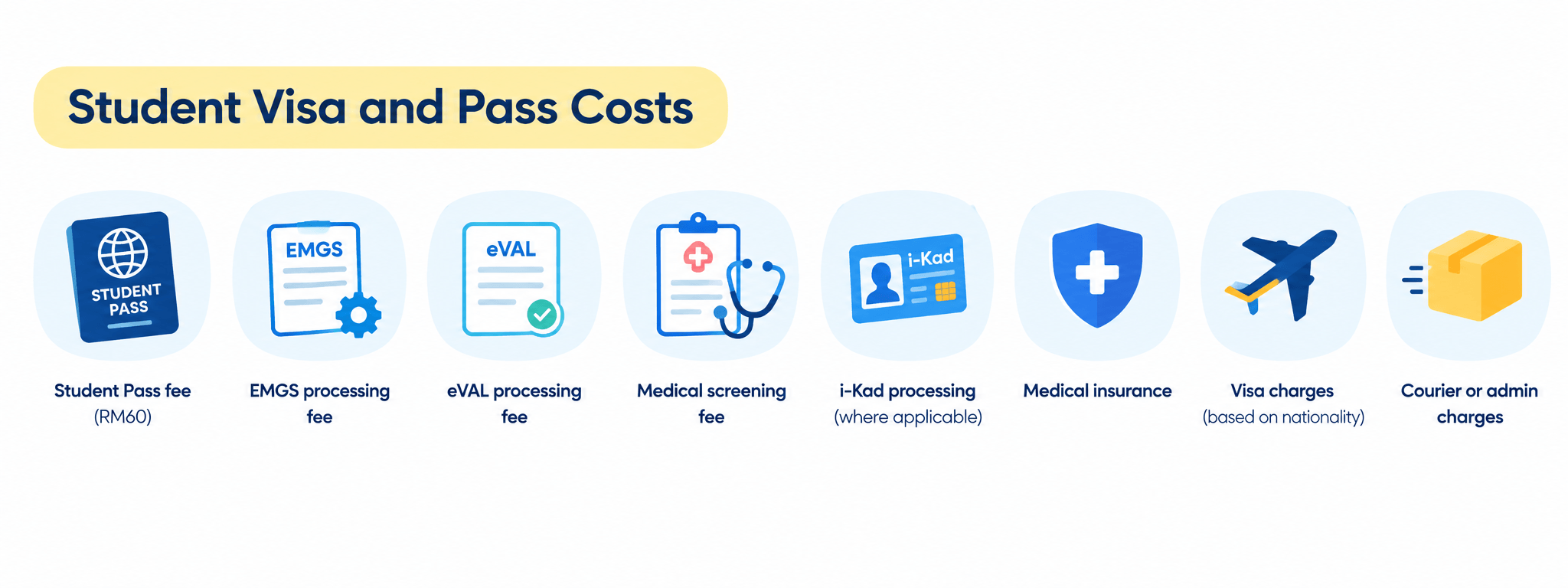
International students need the appropriate Student Pass to study in Malaysia. The application process is generally coordinated through their university and Education Malaysia Global Services (EMGS).
There is no single visa total that applies to every international medical student. Charges depend on the application, pass duration, nationality, insurance selection and the fees applicable to the institution.
The Malaysian Immigration Department lists the Student Pass fee at RM60. Other charges may include:
- EMGS application processing
- Electronic Visa Approval Letter (eVAL) processing
- Medical screening
- i-Kad processing, where applicable
- Medical insurance
- Visa charges based on nationality
- Any applicable courier or administrative charges
You should also confirm the charges for subsequent renewals rather than assuming they will be the same as the first-year application.
When should you apply for your Student Pass?
Start preparing your documents well before your intended intake. As a practical planning measure, allow around 10–12 weeks where possible, while checking the university's current instructions and processing timelines.
Once your Student Pass and travel arrangements are approved, plan to arrive no earlier than two weeks before classes begin. This gives you time to settle into your accommodation and prepare for orientation.
Do not book non-refundable travel based solely on an offer letter. Follow your Easyuni advisor or University's guidance on visa approval and when you can travel.
5. Health Insurance
Insurance is compulsory for all international students for the whole period of study.
What you need to know:
Cost: roughly RM450 to RM750 a year, depending on the plan and provider. EMGS-listed plans run from about RM458 to RM567, and one university's own plan costs RM740.
First year: usually bundled into your visa fee, so you pay for it separately only when you renew. EasyUni's guide also notes that insurance is included via EMGS.
Cover limits: entry-level plans have annual limits (one EMGS plan lists RM20,000), and some charge a small amount per outpatient visit (RM25 on one plan). Read what is covered before you rely on it.
Keep it valid: you need cover for your whole stay. If it expires before your Student Pass does, you must top it up or extend it.
University plans: institutions can arrange their own insurance if it meets Ministry of Higher Education requirements, so ask which plan you will be on.
Clinical years: medical students spend time in hospitals, so ask your university whether you need extra cover.
6. The Costs Students Forget
Budget for these from day one, because they are easy to overlook and they add up over the course. Plan for each one before you commit:
➜ Accommodation deposit: usually one to two months' rent upfront. Have it ready before you arrive.
➜ Settling-in costs such as bedding, kitchen basics, a SIM card and first groceries: about RM500 to RM800.
➜ Flights home and the effect of exchange-rate changes on your family's budget. Fares vary by country and season, so check prices from your city and book early.
➜ Textbooks, uniforms and equipment (stethoscope, lab coat, instruments): costs vary by programme, so set aside extra for these each year.
➜ Clinical placement costs, such as travel or accommodation if your hospital is far from campus: plan for these from your clinical years onward.
➜ Exam, registration and licensing fees: these come up every year, so include them in your annual budget.
➜ An emergency fund for a delayed remittance, illness or a missed flight. Keep a buffer on top of your budget.
7. Ways to Reduce the Cost
There's no magic trick, but these help:
- Compare several universities. The tuition gap between universities can be hundreds of thousands of ringgit.
- Ask about scholarships and fee waivers. Some universities offer merit or progression waivers (for example, IMU lists waivers for its own foundation students), but eligibility and amounts vary, so ask each one.
- Choose a lower-cost city or shared housing. Accommodation is your biggest monthly cost.
- Ask about payment schedules. Fees are usually paid per semester or per year, not all at once.
- Check if you can skip the foundation year with an accepted qualification.
International students can work part-time for up to 20 hours a week, but only during semester breaks or holidays lasting more than 7 days. Eligible jobs include positions in restaurants, petrol kiosks, mini markets and hotels, subject to Immigration approval through your university.
With the workload of a medical course, treat part-time work as a way to earn extra pocket money, not as a reliable way to fund your degree.
8. Is it Worth it?
That depends on your goals, your family's budget and where you plan to practise.
Malaysia's appeal is English-medium teaching, a multicultural environment and living costs that are lower than in many Western countries. But it is not the cheapest MBBS destination, and the fees above are a serious financial commitment.
Two important things to check before you apply:
1. Recognition. Whether a Malaysian MBBS is recognised for licensing in your home country depends on your country's medical council and current rules. Always confirm with the council directly.
2. Where you plan to work. Licensing, internship and residency routes differ by country.
Frequently Asked Questions
1. How much does MBBS cost in Malaysia for international students?
For the universities with published fees verified for this guide, five-year MBBS tuition ranges from approximately RM405,000 to RM734,000, depending on the university and applicable SST. For example, University of Cyberjaya lists RM434,300 in total payable fees, while IMU's tuition may reach approximately RM734,241 if 6% SST applies to the full amount. Living expenses, visa and insurance charges, and other costs come on top.
2. What is the cheapest medical university in Malaysia for international students?
MBBS in Malaysia is a major financial commitment, with tuition alone costing over five years. If you're looking for more affordable options, consider SEGi University, AIMST University and the University of Cyberjaya, but speak to Easyuni advisor to select the best universty based on your budget & goal.
3. Do I need a foundation year before MBBS in Malaysia?
Not necessarily. If you have A-Levels, the International Baccalaureate (IB) or another accepted pre-university qualification with the required science subjects and grades, you may be eligible for direct entry. If you have only completed secondary school, you may need a Foundation in Science or an equivalent pathway, depending on the university's requirements.
4. How much is the student visa for medical students in Malaysia?
Budget approximately RM4,000 for initial Student Pass processing, plus around RM120 for a Single Entry Visa (SEV) if required for your nationality. The exact amount varies depending on your nationality and applicable fees.
5. Is health insurance compulsory?
Yes, international students in Malaysia must have medical insurance that meets the applicable Student Pass requirements. The cost depends on the insurance plan and coverage selected. Premiums insurance packages ranged from about RM458 to RM740 per year.
6. Can international students work part-time in Malaysia?
Yes, but only up to 20 hours a week during semester breaks or holidays of more than 7 days, in specific sectors, with Immigration approval.
7. Are scholarships available for MBBS in Malaysia?
Some universities offer fee waivers or merit awards, but they are limited and vary by university and nationality. Fully-funded scholarship are rare in malaysia for international students.
8. Are tuition fees paid yearly or all at once?
Payment schedules vary by university. Many charge tuition by semester, but some medical programmes may require larger upfront payments or may not offer instalment plans. Check your university's offer letter and payment policy to confirm the required amount and deadlines.
How EasyUni Can Help
Choosing a medical school involves more than comparing tuition fees. EasyUni offers free guidance to help you explore your study options in Malaysia.
Our advisors can help you:
- Compare medical programmes and universities.
- Understand entry requirements based on your qualifications.
- Get guidance on the application process and student visa steps.
- Explore available scholarships and fee waivers.
- Shortlist universities that suit your academic background and budget.
Have Questions About Studying Medicine in Malaysia?
Speak to an EasyUni study advisor for free guidance on university options, fees and application requirements.
📞 Talk to an EasyUni AdvisorKickstart your education in Malaysia
We'll help you find and apply for your dream university
You might be interested in...
- Top Actuarial Science Universities in Malaysia for International Students 2026
- Is an MBA Worth It? 5 Pros and Cons You Should Consider in 2026
- Choosing the right university and course in Malaysia
- Types of English Language Proficiency Tests in Malaysia
- Choosing Between Public or Private University in Malaysia: What is your choice?
- International Students Healthcare Guide in Malaysia
- Living Cost in Malaysia for International Students 2026
- How Can International Students Work in Malaysia After Graduation
- Semester Break Exploration Guide For International Students in Malaysia
- Language and Communication Tips for International Students Studying in Malaysia