





 +60173309581
MBBS in Malaysia for Pakistani Students (2026): Costs, PMDC Rules, & Universities
June 16, 2026
Mehmil
You've got your FSc results. You want to become a doctor.
Private medical colleges in Pakistan are expensive, seats are limited, and the MDCAT competition is brutal — over 200,000 students sit MDCAT every year for roughly 4,000 MBBS seats.
So you start looking abroad. China keeps coming up. Turkey too. And then Malaysia.
But here's what most guides won't tell you upfront: Malaysia is not the cheapest option. It's not a shortcut. A
And there are specific PMDC rules you need to understand before you decide anything.
This article will tell you about costs, universities, PMDC requirements, life as a Pakistani student in Malaysia, and an honest comparison with China and Turkey.
Is MBBS in Malaysia Worth It for Pakistani Students?
👉 Short answer: Yes, but it depends on your priorities and budget.
Malaysia offers English-medium medical education in a Muslim-majority country, with degrees from WFME-accredited institutions eligible for PMDC registration. Clinical training happens in modern hospitals, in English, with no language barrier in wards or with patients.
For a student whose priorities are quality of clinical education, cultural comfort, and a globally portable degree, Malaysia makes a lot of sense.
But it costs more than China or Russia. It's not a "cheap abroad" option. And after you graduate, you still can't practice medicine in Pakistan without passing the National Registration Examination (NRE).
We'll get into all of that.
The PMDC Rules: Read This Before Anything Else
This is the section most students or parents skip or get wrong. Please read it carefully, because getting this wrong costs you years.
MDCAT Is Now Mandatory Before You Leave Pakistan
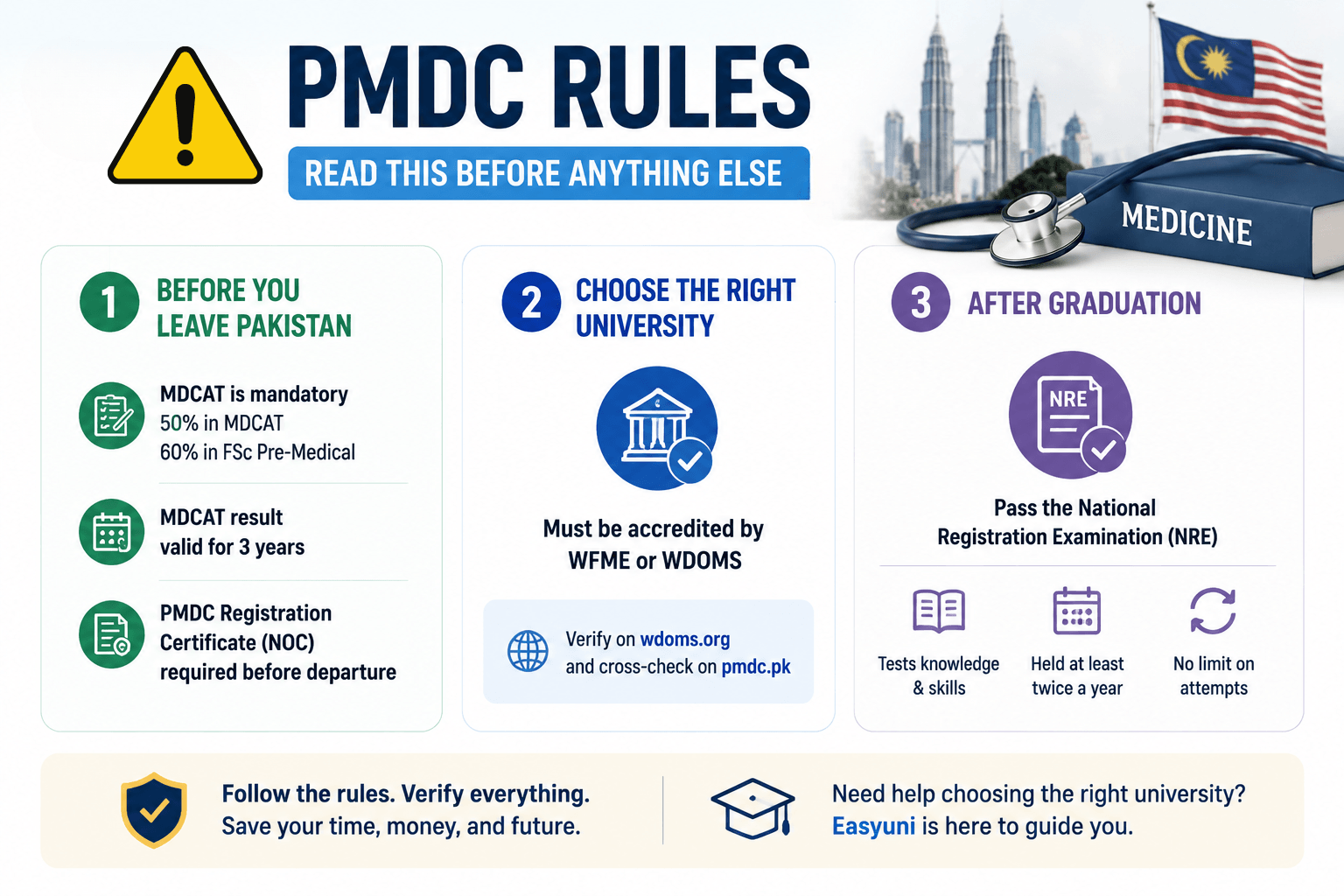
Pakistani students who want to pursue MBBS or BDS abroad must have a minimum of 60% marks in FSc Pre-Medical and 50% marks in MDCAT to be eligible for PMDC registration. This policy applies to students admitted from the September 2024–2025 intake onwards.
What this means practically:
- You must sit MDCAT in Pakistan before you travel, not after
- The MDCAT result is valid for 3 years
- You need a PMDC Registration Certificate (NOC) before departure, without it, your degree may not be recognised on return
- The University Must Be WFME or WDOMS Accredited
- The foreign university must be accredited by WFME or WDOMS, and the qualification must be in Allopathic Medicine.
- Verify on wdoms.org yourself, and cross-check on pmdc.pk before you make any decision.
To make things easy, Easyuni can help you with university & course selection based on your goals & budget.
After Graduation: You Must Pass the NRE
After getting a degree from an accredited medical university abroad, Pakistani students must pass the National Registration Examination (NRE) to obtain full registration from PMDC.
The NRE has been designed to gauge MBBS graduates' competence to practice independently. Passing both the theory and clinical skills components is mandatory for obtaining a full license to practice as a General Practitioner.
The NRE is held at least twice a year, and there is no limit on the number of attempts.
Many students find out about the NRE only after graduating. Knowing about it now means you can prepare for it during your final years, not scramble for it after.
Which Universities Should Pakistani Students Consider in Malaysia?
There are seven universities in Malaysia that offer MBBS or equivalent medical degrees for international students. They vary significantly in ranking, cost, focus, and what type of student they're best suited for.
Here's a clear overview before we go into the details:
⚠️ All costs below are approximate and subject to change. PKR conversions are indicative only.
| University | 5-Year MBBS Cost (Approx.) | QS Ranking | Key Strength |
|---|---|---|---|
| Monash University Malaysia | ~RM 588,000 (~PKR 4.2 cr) | #36 Globally | Globally recognised Australian medical degree. |
| International Medical University (IMU) | ~USD 170,695 (~RM 800,000+) | Top 151–200 | Malaysia's oldest dedicated medical university with 30+ international credit-transfer partners. |
| Sunway University | ~USD 126,072 (~RM 590,000) | #410 Globally | Fastest-climbing private university in Malaysia; operates as a not-for-profit institution. |
| MAHSA University | ~RM 365,000–378,000 (~PKR 2.6–2.7 cr) | #=577 Asia | Dedicated health sciences institution with a strong healthcare focus. |
| Management & Science University (MSU) | ~USD 161,280 (~RM 755,000) | #597 Globally | SETARA Tier 5 (Excellent) with its own medical centre and teaching facilities. |
| SEGi University | ~USD 103,466 (~RM 484,000) | #731–740 Globally | Malaysia's first MBBS programme to receive a QS 5-Stars Plus rating; recognised in Pakistan. |
| University of Cyberjaya (UoC) | ~USD 100,715 (~RM 472,000) | Not QS-Ranked | SETARA Tier 5 (Excellent) university with a 100% focus on health sciences. |
Note: USD figures are estimated, and MYR conversions are approximate. Always verify the latest exchange rates, and other costs.
Now let's break each one down honestly, including what they're genuinely strong at and what you should know before applying.
1. Monash University Malaysia

Monash Malaysia is a branch campus of Australia's Monash University, ranked #36 globally in QS 2026. The medical degree here is called the Bachelor of Medical Science and Doctor of Medicine (BMedSci/MD), and it's awarded as a full Monash University (Australia) qualification, the same degree their Melbourne students receive.
The course is accredited by the Australian Medical Council, meaning graduates can practise in Australia and New Zealand without additional examinations, and is recognised by the Malaysian Medical Council.
Honest take: This is the most globally portable medical degree you can get in Malaysia. If you or your family can manage the cost, it opens doors; especially for those considering further training in Australia or the UK. But it is significantly more expensive than every other option here.
Best for: Students who want the strongest global credential and have the budget for it.
2. IMU — International Medical University
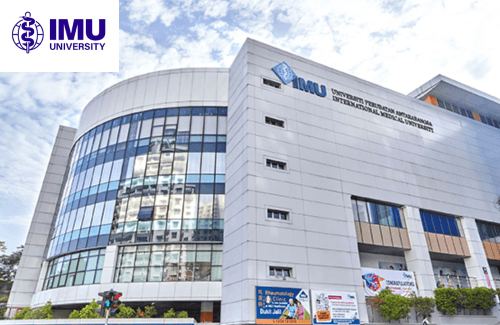
Founded in 1992, IMU is Malaysia's first and most established full-fledged private medical and health sciences university. It offers over 20 health professional programmes at pre-university, undergraduate, and postgraduate levels, and has credit-transfer agreements with over 30 prestigious universities worldwide.
In 2026, IMU University ranks in the top 151–200 globally in QS World University Rankings. It was awarded the SETARA Outstanding 6-star rating — It is the only private Malaysian medical university to receive self-accreditation status from the Malaysian Qualifications Agency (MQA).
Honest take: IMU is the gold standard for dedicated medical education in Malaysia. If ranking and institutional reputation in health sciences specifically matter to you, IMU is hard to argue against.
Best for: Students who are serious about medicine as a career, want the strongest clinical and academic environment in a dedicated medical university, and can stretch the budget.
3. Sunway University
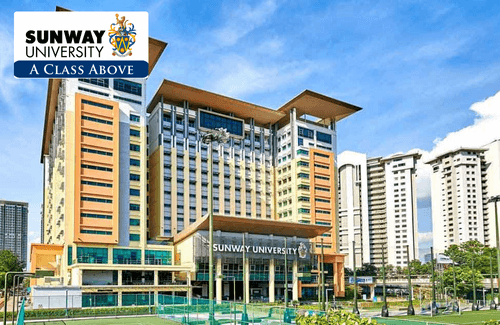
Sunway offers a Doctor of Medicine (MD) programme and is currently the fastest-climbing private university in Malaysia. In the QS World University Rankings 2026, Sunway rose more than 100 spots to land at #410 globally, placing it among the top private universities in Malaysia.
Sunway is the only private university in ASEAN to appear in all three major global ranking systems and has been ranked Malaysia's #1 university for graduate employability for five consecutive years.
Honest take: Sunway's medical programme is relatively new compared to IMU or Monash, but the university's overall institutional strength is undeniable. For students who want a highly ranked, well-resourced university with a strong employability track record, Sunway is a serious contender.
Best for: Students who want a top-ranked private university environment with strong employability outcomes and a broad campus experience.
4. MAHSA University
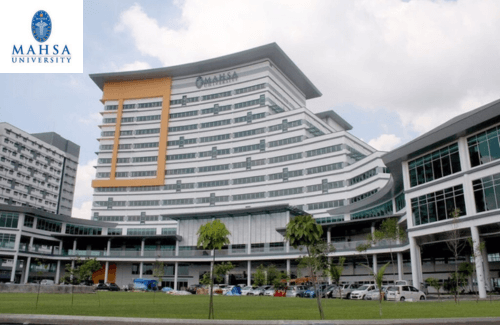
MAHSA has been a dedicated health sciences institution since 2004. Medicine is its core identity, it doesn't offer engineering or business alongside MBBS. It offers various scholarships that can significantly reduce the total payable amount, making it one of the more affordable private medical options in Malaysia.
Recognised by the Malaysian Medical Council (MMC) and listed in WDOMS.
Honest take: MAHSA won't impress anyone with a rankings number, because it doesn't have one in the global tables. What it does offer is focused healthcare education at a meaningfully lower tuition than above options. For families where the total cost is the deciding factor and you want a genuine medical focus (not a large general university), MAHSA makes a lot of sense.
Best for: Budget-conscious students who want a dedicated health sciences environment without the premium price tag of a globally ranked institution.
5. MSU — Management & Science University
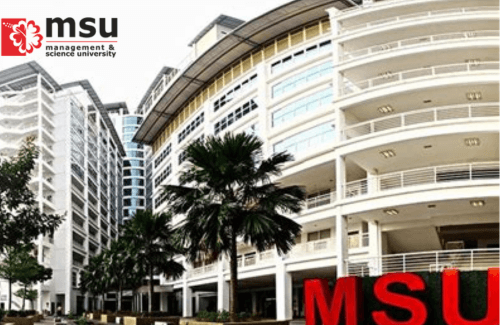
MSU is based and has its own on-campus medical centre, a rare feature among private universities. MSU is ranked #597 in the QS World University Rankings 2026 and has SETARA Tier 5 Excellent status.
Honest take: MSU offers a QS-ranked option with a large, multi-disciplinary campus and a good overall university experience. The MBBS cost, however, is relatively high compared to similarly positioned alternatives. Worth exploring if the campus environment and own medical centre appeal to you.
Best for: Students who want a QS-ranked, larger campus experience and specifically value MSU's medical centre for clinical exposure.
6. SEGi University
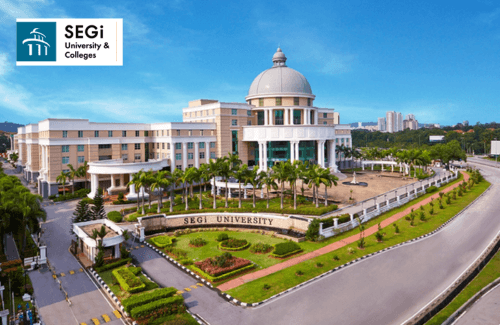
SEGi is Malaysia's largest private higher education group by student numbers — over 16,000 students from roughly 85 countries. It operates multiple campuses, with the main one in Kota Damansara.
SEGi made its debut in the QS World University Rankings 2026, placing in the #731–740 band globally. More importantly for Pakistani students: SEGi's MBBS programme is recognised by medical councils in Malaysia, Thailand, Pakistan, Qatar, and the Maldives. It is also the first MBBS programme in Malaysia to receive a QS 5-Stars Plus specialist rating for medicine.
Honest take: SEGi's explicit Pakistan recognition is worth flagging for Pakistani students, it's one of the few universities that directly states PMDC recognition as a listed credential. The relatively affordable fees for a QS-ranked institution make it worth serious consideration.
Best for: Pakistani students who want a QS-ranked university with explicit PMDC recognition at a more manageable price point.
7. University of Cyberjaya (UoC)
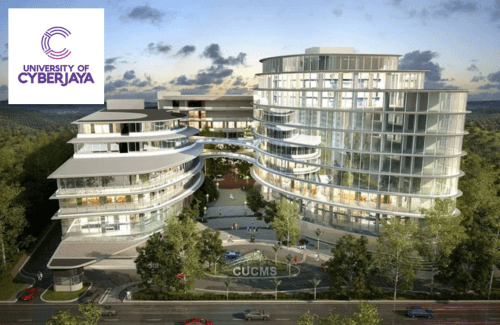
UoC is a 100% health sciences-focused university in Cyberjaya. UoC has a technological and modern advantage, with personalised student support and modern campus facilities. It holds a SETARA Tier 5 (Excellent) rating from the Malaysian Ministry of Higher Education.
UoC is consistently rated highly for healthcare education within Malaysia's local rating system.
Honest take: If you want to be fully immersed in a healthcare environment without the distractions (and higher costs), UoC is a solid choice. It is within Malaysia's healthcare sector, it has a strong reputation. For students where budget and environment matter more than a ranking number, this deserves serious consideration.
Best for: Students who prefer a smaller, healthcare-dedicated campus environment and want to avoid KL's higher cost of living.
What Does MBBS in Malaysia Actually Cost for Pakistani Students?
The total tuition fee for an MBBS in Malaysia typically ranges from PKR 19 million to PKR 45 million+ for the full 5-year programme, depending on the university you choose. More affordable medical universities usually charge around PKR 19–24 million, while top-ranked international medical schools can cost PKR 35–45 million or more.
Monthly Living Costs
Medical students in Malaysia typically live near campus. Budget MYR 1,500–2,000/month (1 lakh - 1.5 lakh pkr) if you're careful, or MYR 2,500–3,000/month for a more comfortable lifestyle. MBBS is demanding, long study hours, clinical rotations — so budget a little extra for food delivery and transport.
Also read: Cost of Living in Malaysia for International Students 2026
One-Time Additional Costs
- EMGS visa application: ~MYR 4,000
- Medical examination (Pakistan): ~PKR 25,000–35,000
- Return flights per year: ~PKR 150,000 - 180,000
- First-year medical equipment (stethoscope, etc.): ~MYR 500–2,000
Admission Requirements for Pakistani Students
Academic:
FSc Pre-Medical with minimum 60% marks (verify current PMDC rules at pmdc.pk before applying)
MDCAT: minimum 50% (some universities set higher internal requirements — check with each one)
PMDC Registration Certificate (NOC): must be obtained before departure
English:
- Most universities require IELTS minimum 6.0 for MBBS
- Students who pursued English-medium education in Pakistan may submit a Medium of Instruction (MOI) certificate as an alternative — confirm with your specific university before applying.
Documents Checklist
✅ Matric & FSc (O-Level & A-Level certificates)
✅ MDCAT result certificate
✅ PMDC NOC / registration certificate
✅ IELTS certificate or MOI letter
✅ Valid passport (minimum 18 months' validity)
✅ Bank statements showing ~MYR 40,000 minimum
✅ Medical examination from approved clinic
✅ Passport photos
What Life Actually Looks Like as a Pakistani Medical Student in Malaysia
🏥 Clinical Training
Years 1–2 focus on pre-clinical learning, including lectures, labs, and anatomy. Years 3–5 involve hospital rotations with early patient exposure and hands-on clinical experience.
📚 Study Demands
MBBS is academically challenging, with continuous assessments throughout the five-year programme. Strong study groups and peer support can help students stay on track.
🎓 Student Life
Pakistani students benefit from halal food, Islamic festivals, active student communities, and a comfortable lifestyle. Living costs typically range from MYR 2,000–2,500 per month.
💙 Mental Wellbeing
Medical school can be demanding, especially while studying abroad. Build a support network early and make use of university counselling services whenever needed.
How EasyUni Can Help You Study in Malaysia
Applying to a university in another country can be confusing, especially when you're comparing dozens of courses, universities, tuition fees, scholarships, and visa requirements.
Our advisors work closely with Malaysian universities and help students find options that match their academic background, budget, and career goals.
What EasyUni Can Help With
✅ University and course recommendations based on your goals
✅ Comparing tuition fees, scholarships, and living costs
✅ Checking admission requirements before you apply
✅ Assisting with university applications
✅ Guiding you through the student visa process
✅ Helping you understand offer letters and next steps
Why Students Trust EasyUni
The biggest advantage is having access to experienced advisors who understand the Malaysian higher education system and can help you navigate the process more confidently.
- Our services are 100% free, and there is no additional fee for receiving advice or application support.
- And most importantly, we stay in contact after you arrive — you are not left alone once you land.
💬 Need Help Choosing the Right Path?
Speak to an EasyUni advisor or message us on WhatsApp for instant guidance on courses, universities, and applications in Malaysia.
Frequently Asked Questions
1. Do I need MDCAT to study MBBS in Malaysia?
Yes. PMDC requires a minimum of 50% in MDCAT conducted in Pakistan before you can register for an MBBS programme abroad and obtain your NOC.
2. Is a Malaysian MBBS degree valid in Pakistan?
Yes — if your university is WFME/WDOMS accredited and you pass the NRE after graduation. Verify your university on wdoms.org and pmdc.pk, not through an agent.
3. What is the NRE and is it hard?
The NRE tests your clinical competence to practice independently as a General Practitioner. It includes both a theory component and a clinical skills examination, and is held at least twice a year. Start preparing for it in your final years — don't leave it to the last minute.
4. Can I stay and work in Malaysia after graduation?
No. The Graduate Pass that allows post-study work in Malaysia is not available to Pakistani nationals under current immigration rules. Plan to return home or explore other pathways independently.
5. Can I work part-time while doing MBBS?
MBBS students are generally not permitted to work under their Student Pass in Malaysia. The workload also makes this impractical; clinical years especially leave very little time.
6. Is MBBS in Malaysia better than China for Pakistani students?
It depends on your priorities. China is significantly cheaper. Malaysia offers stronger English-medium clinical training and better cultural comfort. If budget is your primary constraint, China (with a rigorously verified university) is a reasonable choice. If English-medium clinical quality and Muslim-friendly daily life matter more than minimising cost, Malaysia is the stronger option.
Kickstart your education in Malaysia
We'll help you find and apply for your dream university
You might be interested in...
- Top Actuarial Science Universities in Malaysia for International Students 2026
- Is an MBA Worth It? 5 Pros and Cons You Should Consider in 2026
- Choosing the right university and course in Malaysia
- Types of English Language Proficiency Tests in Malaysia
- 8 Good Study Habits For University Students
- Choosing Between Public or Private University in Malaysia: What is your choice?
- International Students Healthcare Guide in Malaysia
- Cost of Living in Malaysia for International Students 2026
- How Can International Students Work in Malaysia After Graduation
- Semester Break Exploration Guide For International Students in Malaysia